
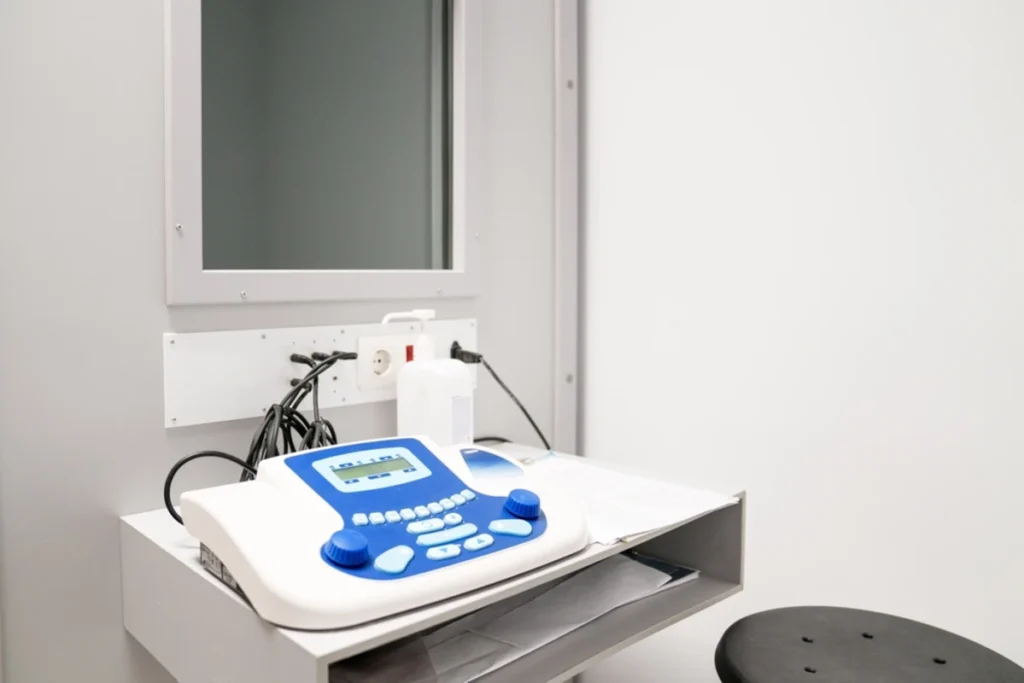
Regular hearing assessments are key to effectively identifying and managing hearing loss, yet most people only visit the audiologist every few years. This neglect can worsen hearing loss, sometimes resulting in irreversible damage.
Fortunately, by understanding the hearing evaluation process, you can confidently identify issues early and preserve your hearing from potential damage. In this article, we’ll guide you through what to expect during a hearing evaluation, from the initial screening to exploring testing options.
Understanding the Types of Hearing Evaluation
Before we dive into the hearing evaluation process, it’s important to understand the various types of hearing evaluations you might undergo. Each type is tailored to identify specific aspects of your hearing ability and pinpoint the nature of any hearing loss you may be experiencing.
The four most common types of hearing evaluations include:
- Pure Tone Audiometry
- Speech Testing
- Tympanometry
- Otoacoustic Emissions (OAE)
Pure Tone Audiometry
This is the most familiar type of hearing test, designed to measure the softest sounds you can hear at various pitches. Through headphones, you’ll listen to tones at different frequencies and indicate each time you hear a sound. This test plots your hearing sensitivity across a range of pitches, creating an audiogram that visually represents your hearing ability.
Speech Testing
Speech tests assess your ability to detect and understand speech at different volumes and in various listening environments. This might involve repeating words presented at a level you can just barely hear to determine your speech reception threshold (SRT), as well as understanding speech in noise to assess your real-world hearing capabilities.
Tympanometry
Tympanometry is not a hearing test per se, but a procedure that evaluates the health of the middle ear and tympanic membrane (eardrum). By varying air pressure in the ear canal, it helps identify issues such as fluid in the middle ear, eardrum perforations, or Eustachian tube dysfunction, which can affect hearing.
Otoacoustic Emissions (OAEs)
OAE testing measures sounds produced by the inner ear in response to a sound stimulus. The absence of these sounds can indicate hearing loss or inner ear damage, making OAEs particularly useful for screening hearing in newborns and young children.
Scheduling Your Baseline Hearing Examination
Your first hearing assessment serves as a baseline for your hearing ability, revealing potential issues and any necessary intervention strategies. The process will vary depending on the type of examination, but the goal is always the same: to identify your current hearing capabilities.
After your evaluation, your audiologist will quantify your hearing ability on the decibel hearing level scale (dB HL). This measurement is based on how loud sounds must be for you to hear them and indicates varying degrees of hearing loss:
- Mild hearing loss: 26 to 40 decibels
- Moderate hearing loss: 41 to 55 decibels
- Moderate-to-severe hearing loss: 56 to 70 decibels
- Severe hearing loss: 71 to 90 decibels
- Profound hearing loss: 91 to 100 decibels
With this information, you can better determine any necessary prevention or intervention strategies to help maintain clear and effective communication.
Interpreting the Results of Your Hearing Screening
After your evaluation, your audiologist will share any necessary or recommended next steps based on your results. If your hearing thresholds are within the normal range, generally up to 25 dB HL, you likely won’t require further intervention. However, it’s still important to schedule regular evaluations to identify and address any issues before they become problematic.
If your hearing assessment reveals a hearing impairment, your next steps will depend on the diagnosis. For individuals with mild to moderate hearing loss, the challenge often lies in detecting soft sounds or understanding speech amid background noise. In such cases, hearing aids might be recommended to enhance speech clarity in certain environments, with settings tailored to the specific patterns of your hearing loss.
For those experiencing more severe hearing loss, conventional hearing aids may no longer provide sufficient support. This may require exploring more powerful alternatives or considering cochlear implants for individuals who find hearing aids inadequate. Cochlear implants offer a different approach by directly stimulating the auditory nerve, potentially improving hearing and speech understanding significantly.
These devices, along with any necessary auditory or psychological therapy, can significantly improve your ability to hear and understand speech. With your audiologist’s recommendations and personal preferences in mind, your evaluation results will guide you toward the most effective solutions for improving your hearing.
Getting Started with Your Hearing Evaluation
With this information, you’re now ready to schedule your hearing evaluation. Whether you experience hearing difficulties or not, this evaluation serves as an important step in your journey toward preserving or even improving your hearing ability.
To get started with your hearing evaluation, get in touch with a local audiologist. Our experts at El Dorado Hearing have years of experience helping people maintain and restore their hearing abilities. Give us a call at 702-857-8188 or take a quiz to learn more!